Featured Events

All News

Graduate Colloquium Event Image

Graduate Colloquium

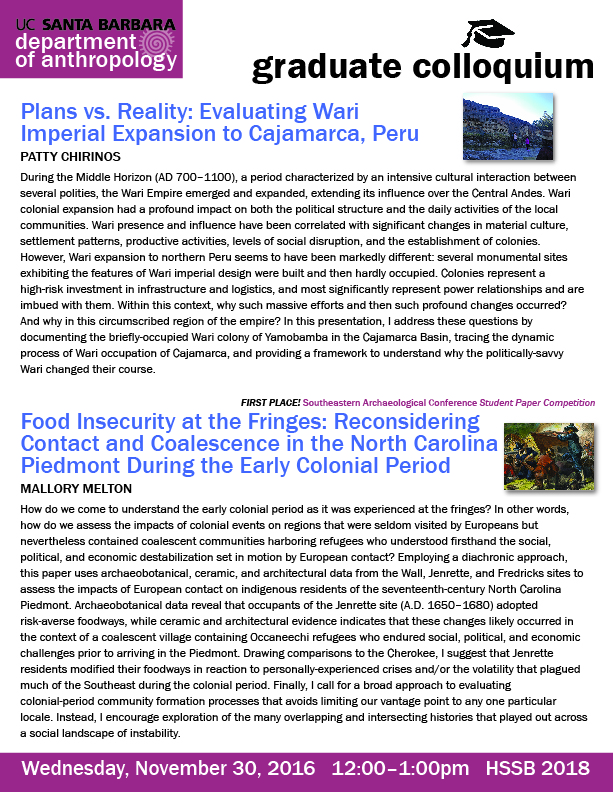
Plans vs. Reality: Evaluating Wari Imperial Expansion to Cajamarca, Peru
Patty Chirinos
 
During the Middle Horizon (AD 700-1100), a period characterized by an intensive cultural interaction between several polities, the Wari Empire emerged and expanded, extending its influence over the Central Andes. Wari colonial expansion had a profound impact on both the political structure and the daily activities of the local communities. Wari presence and influence have been correlated with significant changes in material culture, settlement patterns, productive activities, levels of social disruption, and the establishment of colonies. However, Wari expansion to northern Peru seems to have been markedly different: several monumental sites exhibiting the features of Wari imperial design were built and then hardly occupied. Colonies represent a high-risk investment in infrastructure and logistics, and most significantly represent power relationships and are imbued with them. Within this context, why such massive efforts and then such profound changes occurred? And why in this circumscribed region of the empire? In this presentation, I address these questions by documenting the briefly-occupied Wari colony of Yamobamba in the Cajamarca Basin, tracing the dynamic process of Wari occupation of Cajamarca, and providing a framework to understand why the politically-savvy Wari changed their course.
 
 
Food Insecurity at the Fringes: Reconsidering Contact and Coalescence in the North Carolina Piedmont During the Early Colonial Period
Mallory Melton
 
How do we come to understand the early colonial period as it was experienced at the fringes? In other words, how do we assess the impacts of colonial events on regions that were seldom visited by Europeans but nevertheless contained coalescent communities harboring refugees who understood firsthand the social, political, and economic destabilization set in motion by European contact? Employing a diachronic approach, this paper uses archaeobotanical, ceramic, and architectural data from the Wall, Jenrette, and Fredricks sites to assess the impacts of European contact on indigenous residents of the seventeenth-century North Carolina Piedmont. Archaeobotanical data reveal that occupants of the Jenrette site (A.D. 1650-1680) adopted risk-averse foodways, while ceramic and architectural evidence indicates that these changes likely occurred in the context of a coalescent village containing Occaneechi refugees who endured social, political, and economic challenges prior to arriving in the Piedmont. Drawing comparisons to the Cherokee, I suggest that Jenrette residents modified their foodways in reaction to personally-experienced crises and/or the volatility that plagued much of the Southeast during the colonial period. Finally, I call for a broad approach to evaluating colonial-period community formation processes that avoids limiting our vantage point to any one particular locale. Instead, I encourage exploration of the many overlapping and intersecting histories that played out across a social landscape of instability.

Continue Reading Graduate Colloquium

Graduate Student Sarah Alami Wins Award article image-2016-11-21

Graduate Student Sarah Alami Wins Award

Congratulations to Sarah Alami, who just won best student presentation/paper at the AAAs in Minneapolis (the Evolutionary Anthropology Society section).

Continue Reading Graduate Student Sarah Alami Wins Award


Graduate Colloquium

Cahokian Interactions in the Neighboring Lower Illinois River Valley:  Recent Investigations at the Audrey-North Site
Christina Friberg
 
This presentation provides a summary of recent investigations at the early Mississippian (AD 1100–1150) Audrey-North Site (11Ge20) in the Lower Illinois River Valley (LIRV), addressing questions of social, political, and economic relationships and the culture contact dynamic during the Mississippian transition. Cahokia was the largest Pre-Columbian city in North America and its inhabitants spread aspects of Mississippian culture in much of the Midwest and Midsouth from AD 1050–1350.  After decades of research, scholars still question how Cahokians initiated these distant interactions, and how and why local groups participated in them. It is clear that distance was a factor in in the scope of Cahokia’s widespread economic control and political influence. However, in order to understand the different ways in which groups negotiated contact with Cahokia, this project focuses on both political and economic interaction and the social implications for identity and daily practice in Cahokia’s immediate northern periphery, the LIRV, 100 km north. Ongoing analysis of community organization, foodways, pottery, and stone tools provides insight into the nature of Audrey site residents' ties to groups in Cahokia's American Bottom region.
 
Coffee and snacks will be provided courtesy of AGSA, but you are encouraged to bring your lunch to this lunchtime talk series.

Continue Reading Graduate Colloquium


Graduate Student Mallory Melton Wins Award article image-2016-10-31

Graduate Student Mallory Melton Wins Award

Congratulations to Mallory Melton for winning first place in the student paper competition at the 2016 annual meeting of the Southeastern Archaeological Conference!


Continue Reading Graduate Student Mallory Melton Wins Award


TA Supplemental Training & Pizza Event Image

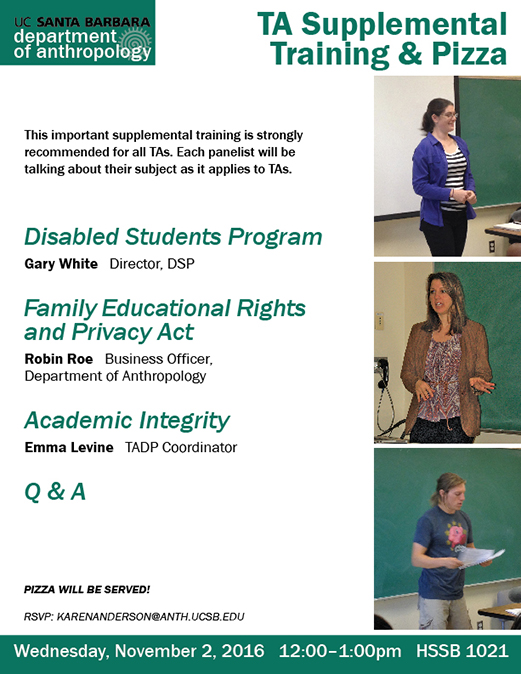
TA Supplemental Training & Pizza

This important supplemental training, strongly recommended for all TAs, will include:
 
* Disabled Students Program - Gary White, Director, DSP
* Family Educational Rights and Privacy Act - Robin Roe,
   Business Officer, Department of Anthropology
* Academic Integrity - Emma Levine, TADP Coordinator
* Q & A
 
Each person will be talking about their subject as it applies to TAs. Pizza will be served!
 
RSVP: karenanderson@anth.ucsb.edu
 

Continue Reading TA Supplemental Training & Pizza


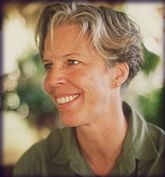
Adjunct Professor Anabel Ford in the News article image-2016-10-03

Adjunct Professor Anabel Ford in the News

Indiana Jones has nothing on Anabel Ford...

Indiana Jones has nothing on Anabel Ford

Continue Reading Adjunct Professor Anabel Ford in the News


Congrats to Tooby, Cosmides, Pisor, and Robertson

On July 2nd, 2016 John Tooby and Leda Cosmides were awarded the Lifetime Achievement award at the annual meeting of the Human Behavior and Evolution Society in Vancouver, BC, honoring their many contributions to the field. As if that weren't enough, Anne Pisor was awarded the New Investigator Award, and CEP graduate Tess Robertson also won the Postdoctoral Award. Quite a showing for UCSB!

Continue Reading Congrats to Tooby, Cosmides, Pisor, and Robertson


Art for Anthropology on exhibit in HSSB 2nd floor Event Image

Art for Anthropology on exhibit in HSSB 2nd floor

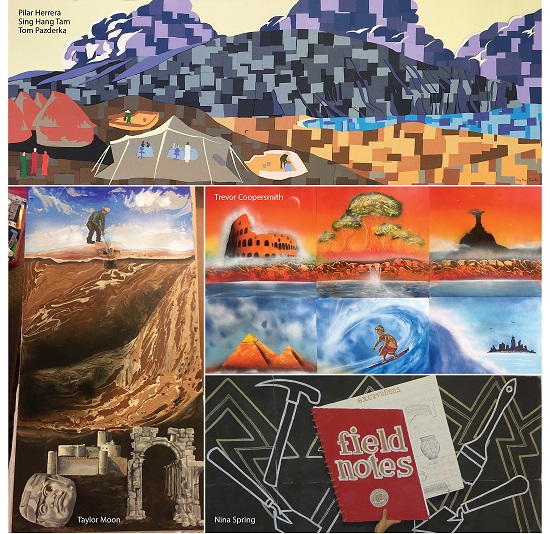
The results of a cooperative project between the Departments of Anthropology and Art now grace the halls of the 2nd floor of HSSB. Art students Trevor Coopersmith, Pilar Herrera, Taylor Moon, Tom Pazderka, Nina Spring, and Sing Hang Tam produced unique interpretations of anthropology for our displays. Come see their beautiful contributions!

Continue Reading Art for Anthropology on exhibit in HSSB 2nd floor