Featured Events
All News

Slavery, Captivity, and the Meaning of Freedom: Conference
jbrooks@history.ucsb.edu
jdelombard@english.ucsb.edu
rmaclean@classics.ucsb.edu
emphasize the slave’s status as property, the concept of “social death” remains highly influential, and yet seems not fully able to encompass advances in the scholarship on smaller-scale forms of human bondage. Some students of slavery prefer to explore the
rubric of “captivity,” which places slaves within the broader class of persons who have been relocated against their will into a new social context, from the ancient Mediterranean to the modern carceral state (Brooks 2002; Cameron 2011). Even the distinction between “slave societies” and “societies with slaves” is subject to fierce contention (Cameron and Lenski, forthcoming). This RFG’s initial and perhaps most invigorating debate will address how to delineate our common object of study, a conversation which happens most effectively across disciplinary lines. Even as we grapple with terms like “slave,” “captive,” “free,” and “unfree,” scholars working on these topics share a core set of questions. The enforced exploitation of labor informs economic and technological history. The master-slave relationship, in its seemingly infinite iterations, epitomizes the negotiation of power in situations of extreme imbalance. Representations of slavery in visual art and text illuminate cultural responses to subjugation and violence. And the ways in which enslaved persons survive or escape slavery, form networks, practice religion, bury their dead, and otherwise fashion their lives problematize the politics of groups in captivity (Brown 2009). Studying modes of accommodation and resistance reveals, in turn, the ideological forces that lead us to perceive the experience of slavery as knowable or invisible, tragic or triumphant. After the abolition or decline of massive slave systems such as those found in the Roman empire and the Americas, the legacies of slavery have proven remarkablytenacious, as have forms of captivity and exploitation that closely resemble legal enslavement. New research linking the ancient and modern worlds includes, for example, incisive studies of the reception of classical Greek slavery (duBois 2003) and of African American and Caribbean writers’ engagement with the Classical tradition (Rankine 2006; Greenwood 2010; Tatum and Cook 2010). In recent years, a renewed emphasis on relationships between capitalism and slavery has produced prize-winning works at the regional, national, and global levels of analysis (Johnson, 1999, 2013; Baptist 2014; Beckert 2014). These force us to confront the persistence of slavery in the 21st century,and to wonder if, indeed, it is intrinsic to human affairs (Bales 1999; Bales and Soodalter 2009).
Grad Student Jenna Santy receives NSF Dissertation Improvement Grant Award
Jenna Santy has been awarded a National Science Foundation dissertation improvement grant to investigate how environmental change affected social organization and community formation during the pre-Columbian occupation of Owens Valley in eastern California. Congratulations, Jenna!
Continue Reading Grad Student Jenna Santy receives NSF Dissertation Improvement Grant AwardAnthropology's First Grad Slam Winners!
Congratulations to Kaitlin Brown (1st Place), Amy Anderson (2nd Place) and Sarah Kerchusky (3rd Place)!
Continue Reading Anthropology's First Grad Slam Winners!
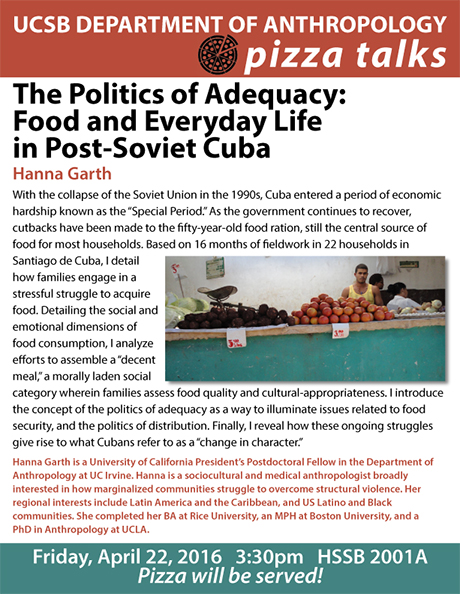
Pizza Talk: The Politics of Adequacy: Food and Everyday Life in Post-Soviet Cuba

Professors Lynn Gamble and Anabel Ford to give book signing
Dr. Anabel Ford and Dr. Lynn Gamble have been conducting groundbreaking research in the field of anthropology. Come meet with them and learn more about their work as they sign their brand new books!
Continue Reading Professors Lynn Gamble and Anabel Ford to give book signing
'First Coastal Californians' by Prof. Lynn Gamble, book signing January 13, 2016
California’s history, like a Hollywood romantic comedy, is often considered skin deep and inconsequential. A new book edited by a UC Santa Barbara anthropologist, however, has the potential to dramatically reshape that perspective. “First Coastal Californians” (School for Advanced Research Press, 2015), edited by Lynn Gamble, a professor in the Department of Anthropology, provides an expansive and accessible view into 13,000 years of human history in the state.
Continue Reading 'First Coastal Californians' by Prof. Lynn Gamble, book signing January 13, 2016
Former Anth Grad Student Megan Carney to give talk January 12, 2016
How does the experience of hunger and food insecurity contribute to the uneven distribution of life chances across borders? What are the conditions displacing increasing numbers of women and families across borders? How does gender shape corresponding experiences of food insecurity and health vulnerability for migrants in the United States?
Megan A. Carney, a lecturer in Integrated Social Sciences at the University of Washington, Seattle, will address these important questions while sharing from her recent book, The Unending Hunger (University of California Press, 2015), an ethnography that underscores the ways that food insecurity exacerbates health vulnerabilities in women’s experiences of migration from Mexico and Central America to the United States.
Sponsored by the IHC’s Community Matters series and the Foodbank of Santa Barbara County.
Event Date: Tuesday, January 12, 2016 - 4:00pm to 5:00pm
Event Location: McCune Conference Center 6020 HSSB
Continue Reading Former Anth Grad Student Megan Carney to give talk January 12, 2016